24 vs 36 Hour Fast: Which Is Better for You?
Compare a 24 vs 36 hour fast by ketosis, hunger, safety, workouts and adherence, with clear guidance on which duration fits your routine.
You finished dinner at 7 p.m. and started a timer. Tomorrow evening you hit 24 hours, right when the kitchen is open and everyone else is sitting down. You can stop there, or sleep through another night and eat breakfast, turning one skipped day into a 36-hour fast.
That extra stretch feels like proof you took the plan seriously. It isn't automatically a better result. A 24 vs 36 hour fast choice is about whether those added hours still help once weekly food intake, sleep, training, and the odds you'll repeat the plan are counted.
Thirty-six hours can deepen a ketone shift for some people. It doesn't promise more fat loss, steadier glucose, or an easier week. What follows is for generally healthy adults comparing the two lengths. It isn't a prescription, and it isn't a toughness contest.
Should You Extend a 24 Hour Fast to 36 Hours
The choice shows up on the clock. Dinner at 7 p.m. puts 24 hours at the next evening's meal. Continuing until the following morning makes it 36. One version ends with a normal dinner. The other asks you to sleep hungry and wake up still fasting.
Thirty-six hours isn't automatically superior. The added window can push glycogen lower and ketones higher, especially if the last meal was lower in carbohydrate. It can't promise a fixed fat-loss edge, a calmer appetite, or a week that still fits work and family. Two people can finish the same timer and land in different states, because the meal before the fast and their usual fuel use both matter.
Judge the extension by what you can live with:
Hunger pattern: Does appetite stay manageable, or does it spike late and drive a huge first meal?
Sleep: Can you fall asleep and stay asleep on the second night?
Ketone response: Is there a measurable rise, or only a longer empty stretch?
Post-fast eating: Does the next meal stay ordinary, or does it erase the gap?
Workouts: Can you train without a sharp drop in quality?
Medication or medical conditions: Would glucose, blood pressure, or a food-timed dose make this unsafe without a clinician?
Repeatability: Could you do this again next week without rearranging your life?
If weekly intake and adherence end up similar, the longer fast may only add friction. A grounded view of weight loss and fat burning starts with energy balance, not with the longest timer you can survive. Before you stretch a window, Empire Medical Wellness explains intermittent fasting in terms of structure rather than grit.
The better question isn't "Can I last?" It's whether the extra 12 hours still help after the week's food and the habit of repeating it are counted.
What Happens in the Extra 12 Hours
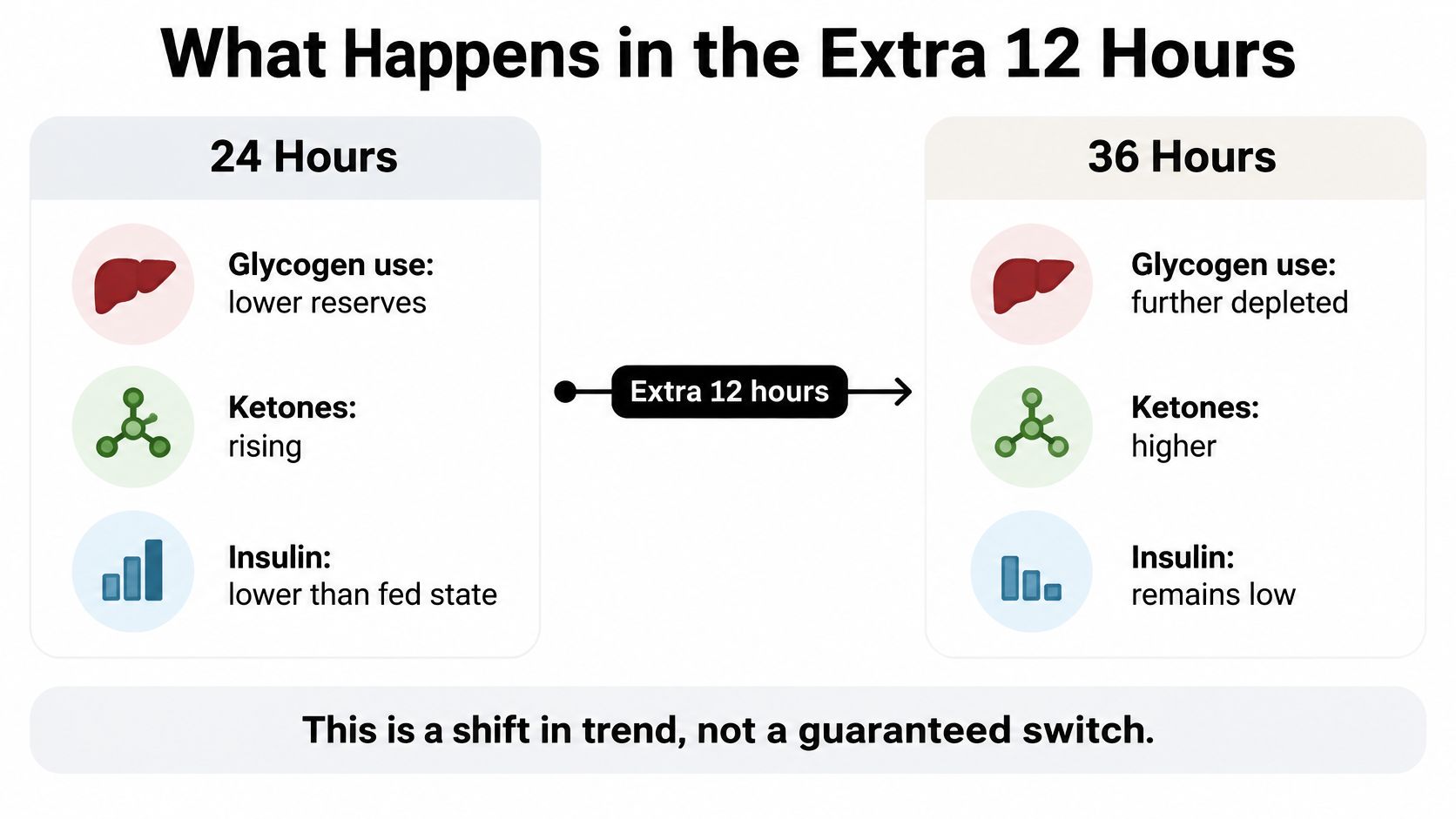
Stopping at 24 hours and continuing to 36 is a drift, not a guaranteed switch. Liver glycogen is already falling through the first day. By the second morning it's usually lower still, insulin stays below a fed-state level, and the liver makes more ketones from fat. Appetite often changes too. Sometimes it quiets. Sometimes it gets louder, especially if sleep was poor.
The same clock time doesn't produce the same blood result.
Last meal changes the ketone clock
In a controlled comparison, nutritional ketosis, defined as blood beta-hydroxybutyrate (BHB) of at least 0.5 mmol/L, arrived on average after about 12 hours when people started fasting after a low-carbohydrate, high-fat meal. After a high-carbohydrate, low-fat meal, average BHB stayed below that line even at 24 hours, reaching only 0.31 ± 0.21 mmol/L, according to a controlled study of meal composition and fasting ketosis. Duration is one variable. The plate before the fast is another.
A separate 36-hour intermittent-fasting study in that same report found an approximately fourfold post-fast rise in circulating BHB, and the BHB response was 2.5 times greater than after a 20-hour fast under a comparable protocol. That's a stronger ketone signal. It isn't proof of greater fat loss. Comparisons of fasting strategies point to energy balance and adherence as major determinants, while fasting-specific metabolic advantages aren't consistently shown.
What the trend map can and can't say
Read the diagram as a direction, not a promise. Glycogen use goes from lower reserves toward further depletion. Ketones move from rising toward higher. Insulin is already below the fed state at 24 hours and tends to stay low. The line on the graphic is the right caution: this is a shift in trend, not a guaranteed switch.
Someone who ate a large pasta dinner may still sit under the ketone threshold at 24 hours. Someone who ate a higher-fat, lower-carb dinner may already be there by midday. For a fair 24 vs 36 hour fast comparison, write down fasting length next to the carbohydrate content of the last meal. Two people can both "do 36 hours" and show substantially different ketone responses. If fat loss is the goal, the honest scoreboard is weekly calories and whether you stick with the plan.
24 vs 36 Hour Fast by Practical Criteria
Rank the two lengths by what they do to your day, not by which one sounds more advanced.
| Criterion | 24-Hour Fast | 36-Hour Fast | Better Fit When |
|---|---|---|---|
| Difficulty | One skipped day, dinner to dinner | Full day plus a second night | You want a test you can repeat |
| Ketone signal | Often rising, and meal-dependent | Usually stronger if you tolerate it | Curiosity about ketones, not the scale alone |
| Sleep and morning | One night, then a normal meal rhythm | Second night while still fasting | Mornings need to stay ordinary |
| Training quality | Easier to keep a moderate session | More likely to feel flat next morning | The week's hard sessions matter |
| Hunger rebound | Shorter empty stretch | Longer stretch, larger first-meal risk | Rebound eating is already a pattern |
| Medication complexity | Still needs a check if doses are food-timed | More hours without food around those doses | Glucose or blood-pressure medicine is in play |
| Weekly repeat | Fits many schedules | Harder to place around work and family | Consistency beats a single long fast |
Glucose control is the wrong trophy
Longer is easy to sell as deeper. The glucose data doesn't cooperate.
In a randomized crossover study, a 24-hour fast significantly impaired insulin sensitivity on a clamp compared with a 12-hour fast (P = 0.002). A single prolonged fast can transiently worsen post-fast glucose handling rather than improve it, as reported in clamp research on prolonged fasting and insulin sensitivity.
In adults with well-controlled type 1 diabetes, a small controlled trial found similar average interstitial glucose during 12-hour and 36-hour fasts, 138 ± 35 versus 130 ± 17 mg/dL (P = 0.44). BHB was significantly higher after 36 hours (P = 0.0006). Those findings stay inside a medically monitored, well-controlled group. They don't extend to people on glucose-lowering medication, with diabetes complications, or at risk of hypoglycemia.
Longer fasting can raise metabolic stress without reliably improving glucose control.
Twenty-four hours is the more conservative benchmark for testing tolerance and keeping a normal day. Thirty-six hours offers a stronger ketosis signal and asks for closer attention to hydration, symptoms, refeeding, and medication timing. Neither length is universally safer or more effective.
How to read the rows
Difficulty and repeatability usually decide the week before ketones do. If the second night wrecks sleep, the morning workout drops, and dinner becomes a catch-up meal, the ketone bump didn't buy a better week. If you already fast overnight comfortably, train light, and eat a measured first meal, an occasional 36-hour fast is a reasonable experiment, not a required upgrade.
Medication complexity is the row people skip. A dose that assumes breakfast isn't a minor detail once the fast covers two mornings. That's a clinician question, not a timer setting.
Safety Symptoms and Who Should Avoid 36 Hours
The usual failure of a 36-hour fast is ordinary. You feel worse, sleep badly, then eat past hunger because the timer "worked."
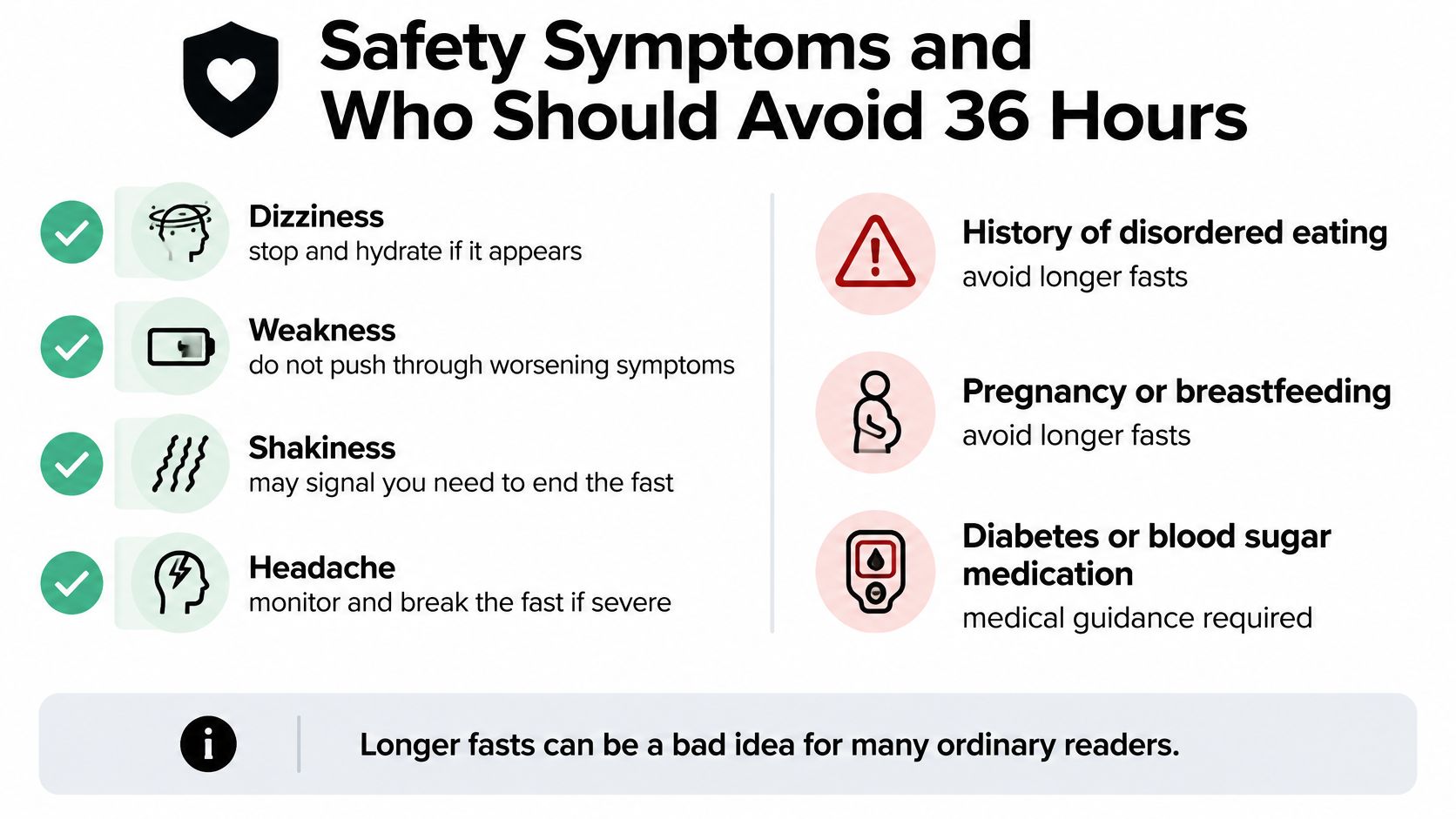
Medical guidance lists dizziness, weakness, headache, impaired concentration, sleep disturbance, nausea, constipation, mood effects, and binge eating, and it's plain that fasting is unsuitable in pregnancy, breastfeeding, childhood, eating-disorder histories, and some medication schedules, as summarized in Australian general practice guidance on fasting fads and facts. People with diabetes, or those on blood-pressure or heart medicines, can face extra risk from glucose changes or electrolyte imbalance on longer fasts.
Stop rules, not vibes
Dizziness: Stop, sit, and drink. Don't wait to see if willpower fixes it.
Weakness that's getting worse: End the fast. Pushing through is how a tolerable day becomes a bad one.
Shakiness: Treat it as a reason to eat, not as a ketone badge.
Severe or persistent headache: Break the fast. A mild one with normal fluids can be watched. A pounding one shouldn't.
Nausea, confusion, fainting, or heart pounding: Stop and get medical help.
Sleep loss: A broken second night makes the next morning feel worse than the clock suggests. That's a reason to choose the shorter fast next time.
Keep water nearby, and unsweetened tea or black coffee if you already drink them. A fast isn't successful because the timer finished. It's tolerable only if symptoms stayed mild and the next meal didn't turn into a binge.
Who should not self-experiment
Don't use 36 hours as a personal test in pregnancy or while breastfeeding, for a child, or with a history of disordered eating. Skip unsupervised longer fasts when a medicine must be taken with food, or when diabetes, blood-pressure medicine, or heart medicine makes glucose or electrolytes a real concern. Clinician input comes before the attempt, not after a bad morning.
Shorter overnight gaps are a different conversation. If you want the case for a modest nightly fast rather than a day and a half, how overnight fasting supports weight loss is a calmer starting point.
Practical rule: Stop for severe or persistent symptoms, keep fluids up, and judge the fast by the next meal and how you slept, not by a completed timer.
Which Duration Fits Your Goal and Schedule
Match the length to the week you have.
A beginner who has only tried overnight fasting should stay at or below 24 hours. The skill to learn is ending on purpose, with a normal meal, not surviving an extra morning.
A busy parent usually does better dinner to dinner. School pickup, a late practice, and a shared evening meal all land near 24 hours. Stretching to breakfast collides with the lunchbox hour and with everyone else's food.
Someone who trains early should default to 24 hours on hard days. A second fasted morning is a poor place for heavy lifting or intervals. Easy walking can fit either length. Strength work belongs on fed days, and how to gain muscle still depends on protein and progressive training around the fast, not inside the longest empty window.
A person who rebounds on weekends should be suspicious of 36 hours. The longer the gap, the easier it is to treat the breaking meal as a reward. If the week's calories land in the same place either way, the extra 12 hours added difficulty without payoff.
An experienced faster who already sleeps through a full fasting day, keeps sessions easy, and eats a measured first meal can try 36 hours now and then, from curiosity about ketones rather than as a weekly requirement.
Place it on the calendar
Workdays: Twenty-four hours, ending at dinner, keeps meetings and the commute simpler.
Travel days: Don't stack 36 hours on jet lag, airport food, or a missed water bottle.
Hard training blocks: Keep the fast off the day before and the morning of the key session.
Family meals: If Sunday dinner is the social anchor, a dinner-to-dinner fast protects it. A fast that runs until Tuesday breakfast often means you skip the gathering or break the plan in the middle.
Twenty-four hours wins when the goal is consistency, fewer decisions, and a schedule other people can live beside. Thirty-six hours fits an occasional experiment for someone already comfortable overnight and through the next day, who still eats appropriately afterward.
How to Test Each Length Without Guesswork
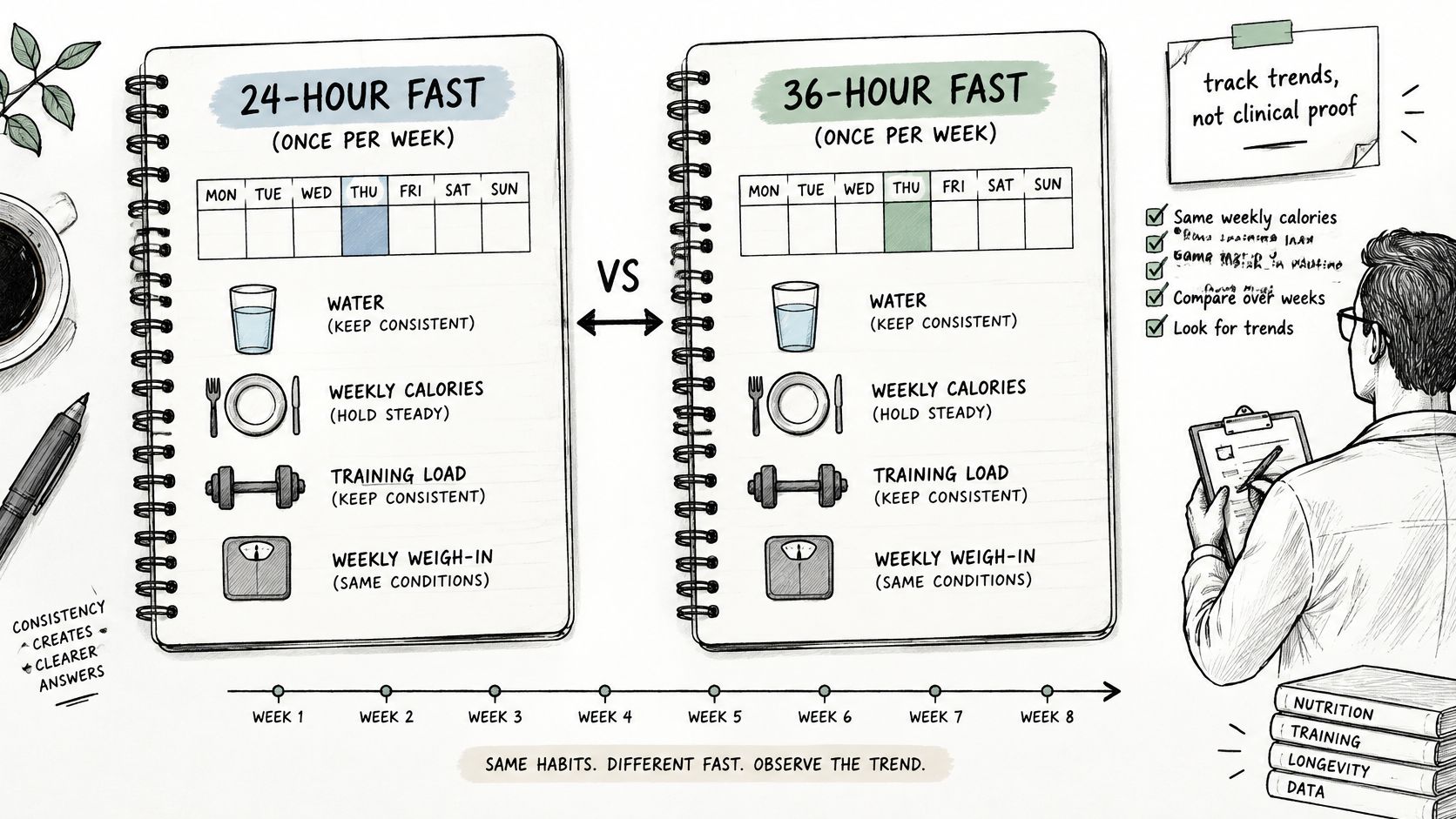
A fair personal trial changes one thing: fasting length. Hold weekly calories, training load, bedtime, and the style of the first meal as steady as you can for several weeks. Otherwise you can't tell whether 36 hours did anything the shorter fast wouldn't have done.
What to log
Start and end: Clock time, not a vague "I skipped lunch."
Last meal: Especially carbohydrate intake, because that changes the ketone timeline.
Water: Rough intake, plus whether a headache showed up when fluids were low.
Sleep quality: Both nights, scored as good, fair, or broken.
Hunger and symptoms: A short note, not a diary.
Workout: What you planned versus what you finished.
First meal after: Size and rough macros, because rebound is the hidden variable.
Photo or voice meal logging makes that first meal easier to capture than a typed reconstruction at 9 p.m. Calorie and macronutrient counts show whether the refeed erased the gap. Workout, sleep, water, and fasting records belong together so the week isn't split across notes. Navilo Health is one consumer option for that combined log, with a fasting timer, live countdown, and custom durations next to meal, workout, sleep, and water tracking. It records observations. It doesn't turn them into a clinical result. If you're comparing fasting apps, the Navilo Health and Zero comparison is a feature check, not a verdict on which fast is healthier.
Why the trial has to count the week
There's no fair head-to-head of 24 versus 36 hours in the popular write-ups. A 2025 network meta-analysis of 99 randomized trials found that intermittent-fasting strategies generally produced weight outcomes similar to continuous calorie restriction. Alternate-day fasting showed only small-to-moderate additional benefits for weight, body composition, lipids, and systolic blood pressure, as covered in Medscape's report on that fasting meta-analysis. Older metabolic work on 36-hour intervals reported lower insulin but no significant glucose change in a small, non-obese sample, so it doesn't generalize.
The useful question is whether 36 hours still helps after weekly calories, meal timing, sleep, and adherence are counted. Your log can show your pattern. It isn't a clinical conclusion.
A short walkthrough of how people time a longer fast makes the dinner-to-breakfast version concrete before you try it.
Run two or three weeks at 24 hours, then one or two trials at 36 only if sleep, training, and the first meal stayed steady. If adherence drops, the longer fast lost.
The Better Choice for Most People
For most generally healthy readers, 24 hours is the more repeatable benchmark. It fits an overnight-plus-one-meal rhythm, keeps the next morning ordinary, and gives enough signal to judge tolerance without turning the week into a recovery project.
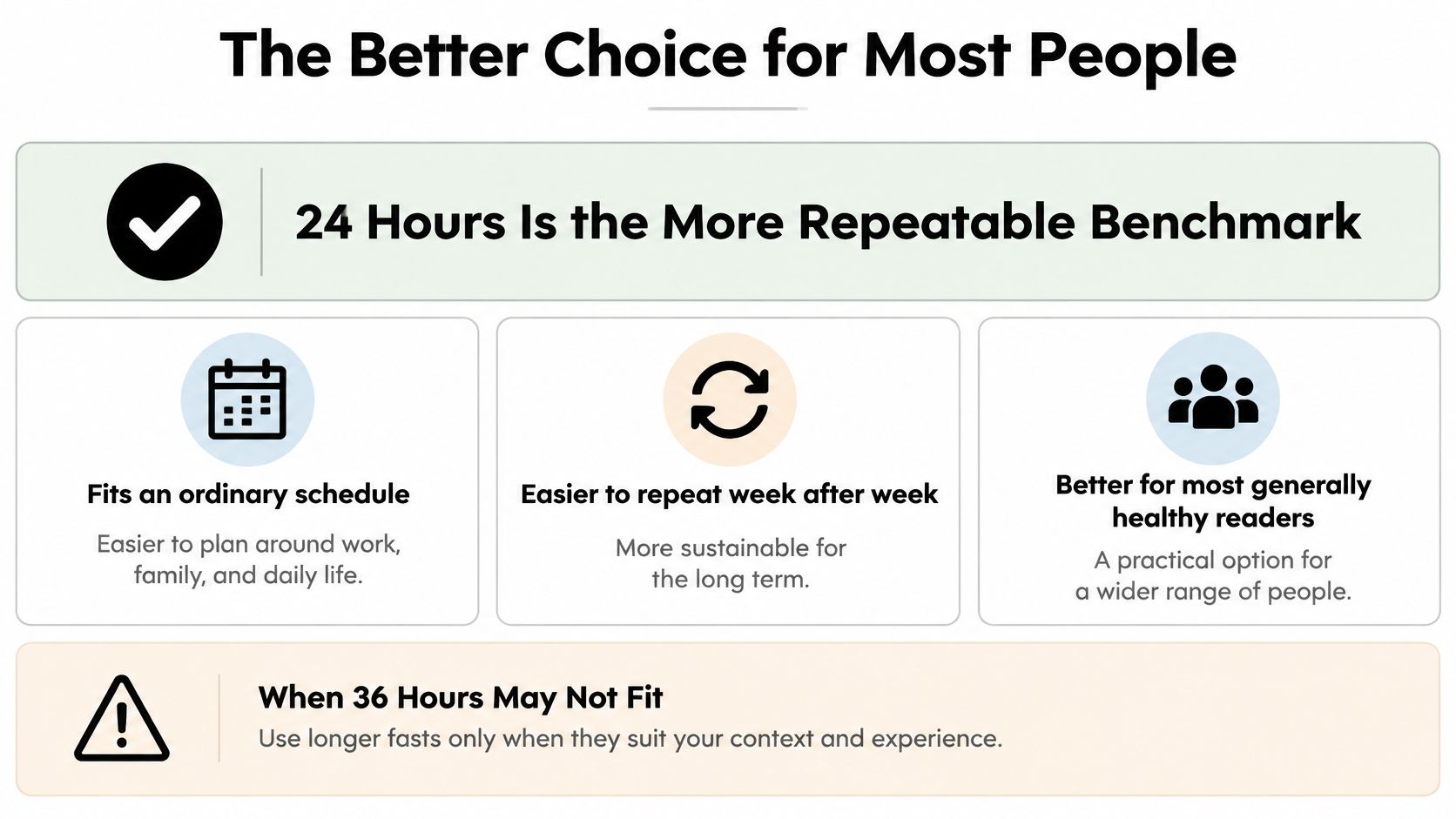
Reserve 36 hours for experienced fasters who sleep well during it, keep training light, have no relevant medical or medication issues, and still eat appropriately afterward. The shorter fast can be the better one when extra hours bring symptoms, poor sleep, worse workouts, or compensatory eating.
This week, pick one 24-hour window and repeat it for two weeks. Note duration, the last meal, hydration, sleep, workouts, and the first meal after. Test 36 hours only if that shorter routine stays calm, repeatable, and medically appropriate for you.
Navilo Health is an AI health companion for logging meals by photo or voice, counting calories and macronutrients, and tracking workouts, sleep, water, and fasting in one place. If you're weighing a 24 vs 36 hour fast, that single log is what shows whether the extra hours still help after intake, sleep, and training are counted. Visit Navilo Health and record your next fasting window alongside the meal that ends it.