
Calories in Fried Rice: What Changes the Total
Calories in fried rice depend on the portion, oil, rice, protein, and extras. Learn reference numbers and how to log the plate you actually eat.

A common reference for fried rice is about 174 calories per 100 grams, or roughly 232 calories for a 133-gram cup. The plate or takeaway container in front of you can be far from that cup.
That's why the usual advice to search for a cup of fried rice and save the first result can lead to a poor estimate. Start with the amount you're eating, then account for the recipe.
Why Fried Rice Calories Are Not One Number
The cup-number habit starts with a reasonable question and ends with an assumption. You search for calories in fried rice, find a familiar-looking entry, and apply it to whatever's on your plate. But the entry describes a particular portion and preparation, not every meal sold under that name.
A measured cup from a home skillet and a deep takeaway box aren't interchangeable. Even when both meals look like ordinary egg fried rice, the amount served and the ingredients mixed through it can differ. Saving both as the same generic serving hides those differences.
Start with the meal you have
Treat serving weight as the first thing to resolve. This isn't a claim that ingredients don't matter. It's a practical order of operations: establish how much food you ate before fine-tuning what was in it.
Keep these questions separate:
- Amount on the plate: What portion will you eat, rather than what did the restaurant provide?
- Rice content: Is the mixture mostly rice, or are other ingredients taking up substantial space?
- Cooking fat: Was the oil measured, added freely, or unknown?
- Protein: Does the dish contain egg, meat, seafood, or a combination?
- Vegetables and sauce: What else changed the mixture, including sauces added at the table?
A useful calorie entry describes your meal. It doesn't just match the name on the menu.
Adjust the recipe without losing the meal
You don't have to turn fried rice into a different dish to make the portion easier to manage. A sensible approach is to keep the ingredients you enjoy, measure what you can, and change the parts that don't add enough satisfaction to justify their place in the recipe.
For a related cooking resource, Just Cook It's guide to cut spaghetti calories without sacrificing flavor addresses that same practical question in another familiar meal.
The useful outcome isn't an official fried-rice number. It's an estimate you can explain, with a clear distinction between portion uncertainty and recipe uncertainty.
A Reference Point for Calories in Fried Rice
A reference entry is useful when you understand what it represents. It provides a starting calorie density, not a guarantee about a restaurant's recipe or the contents of your skillet.
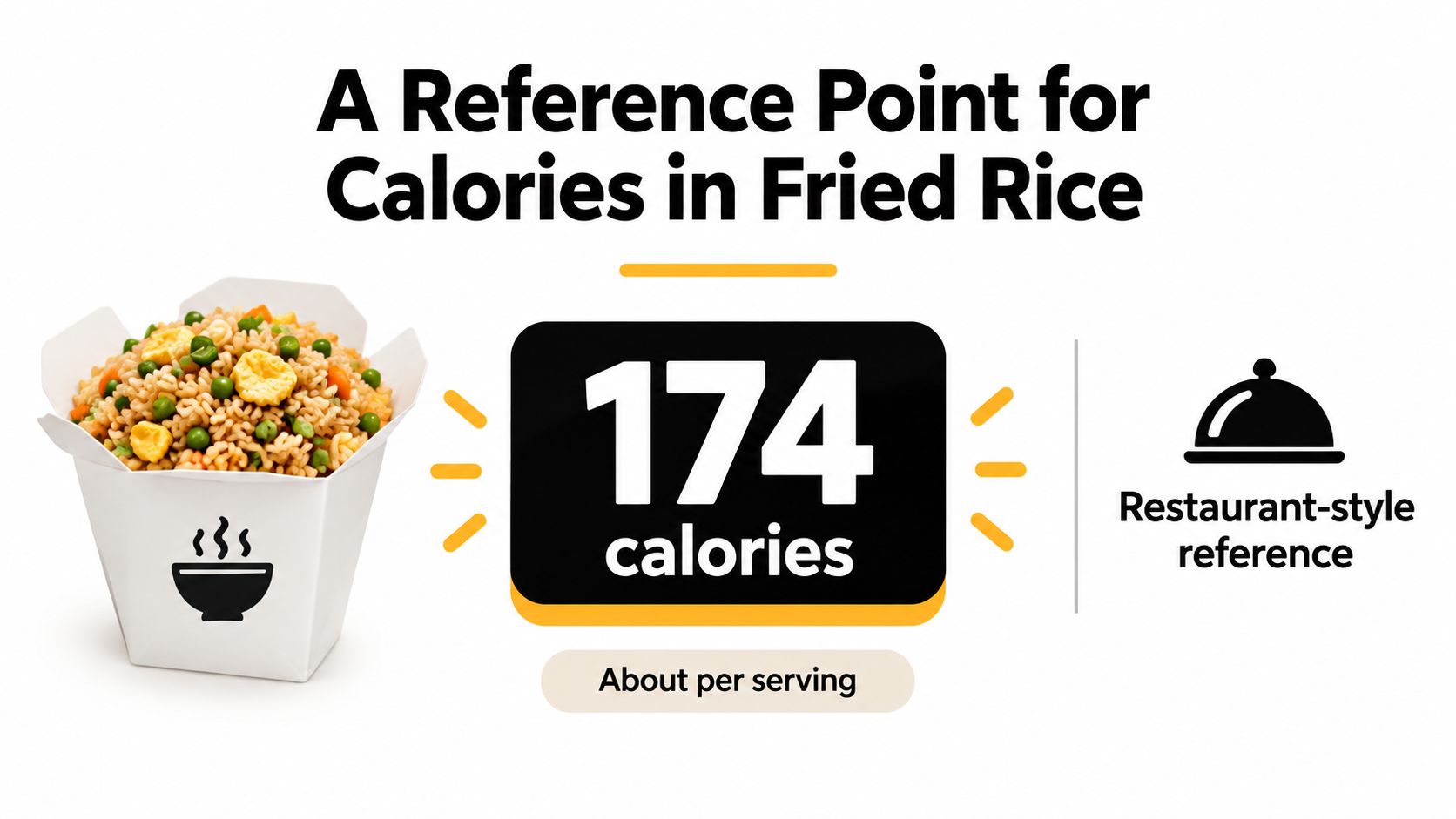
The commonly reported restaurant-style reference is about 174 calories per 100 grams, with 4.1 grams of protein, 32.8 grams of carbohydrate, and 3.0 grams of fat; a separate entry using that density lists a 133-gram cup, which works out to approximately 232 calories, while the reported carbohydrate range of 32.5–32.8 grams per 100 grams gives roughly 43 grams per cup; scaling the same density gives about 348 calories at 200 grams and 522 calories at 300 grams, as described in the fried-rice calorie and serving reference.
Read the unit before the number
The essential distinction is per weight versus per serving. A weight-based reference tells you how much energy is associated with a defined mass of food. A serving label only helps when you also know how much that serving weighs.
The graphic below highlights the reference number. Its serving wording needs that qualification: the reference applies per the weight stated above, not to every bowl or takeaway portion.
Use the baseline as a density check
The scaled examples isolate the effect of serving weight by holding the recipe constant. They don't imply that every portion of that weight contains exactly the reference calories.
Use the baseline to ask practical questions:
- Does the preparation resemble the entry? A richer restaurant mixture may need a different estimate.
- Does the serving unit match? Don't select a cup entry when you've measured grams unless the conversion is clear.
- Does the nutrition profile make sense? A rice-heavy mixture should be considered differently from a version with substantial protein and vegetables.
Oil, egg, meat, sauces, and vegetables can move the actual total away from the baseline. A lower-oil preparation with more vegetables may be less energy-dense, while a richer restaurant version may be higher.
Resist the urge to make a reference entry more precise than the recipe allows. A measured portion paired with a reasonable recipe match is more useful than a highly specific calorie total attached to an unknown amount of food.
How Serving Size Changes the Calorie Total
A takeaway container is packaging, not a measuring tool. Its apparent size doesn't tell you how tightly the rice is packed, how much sits below the visible surface, or how much you'll leave behind.
The portion-size discussion and reported fried-rice examples give cup estimates of approximately 289–354 calories across several USDA examples and describe restaurant or takeaway portions of roughly 350–500 grams, reaching approximately 600–870 calories. These are different reported references, not a conversion rule that makes every cup or container equivalent.
Fried Rice Portion References
| Portion reference | Reported amount | Approximate calories |
|---|---|---|
| Cup entries in the reported examples | A cup, with recipe and weight varying | Within the reported cup range above |
| Restaurant or takeaway portion | A larger portion within the reported weight range above | Within the reported takeaway range above |
| Your measured home portion | The amount you actually serve | Depends on the recipe and measured amount |
| Part of a takeaway container | Only the amount consumed | A corresponding share of the estimated full meal |
The comparison matters because a cup is a volume measure. A leveled measuring cup at home gives you a defined volume; a loosely filled takeaway scoop or a heaped bowl doesn't establish the same amount. Even a measured cup still needs a suitable food entry because the mixture itself can vary.
Choose the strongest measurement available
Use grams first. Place an empty plate or bowl on a kitchen scale, tare it, then add the food. Weigh the finished mixed dish, not just the rice before the other ingredients went in.
Use a measured cup when a scale isn't available. Transfer the food into an actual measuring cup rather than deciding that a bowl looks cup-sized. Record that you used a volume estimate so you don't later mistake it for a weighed serving.
Use a visual comparison as a fallback. A photo or a description can preserve useful context, but it leaves more uncertainty about depth and packing.
- For a shared container: Serve your own portion before estimating it.
- For leftovers: Record what you ate, not everything originally purchased.
- For partial containers: Estimate the full amount, then apply the fraction consumed rather than saving the whole box as your meal.
Practical rule: Resolve a large uncertainty about portion size before spending time choosing between nearly identical food-entry names.
This is why serving size deserves attention before debates about rice color or protein choice. The practical risk is selecting a reasonable entry and applying it to an amount of food that bears little resemblance to its serving description.
Rice Oil Protein and Additions on the Plate
Once the portion is established, look at its composition. Weight tells you how much food is present; the recipe helps determine what that weight means nutritionally.
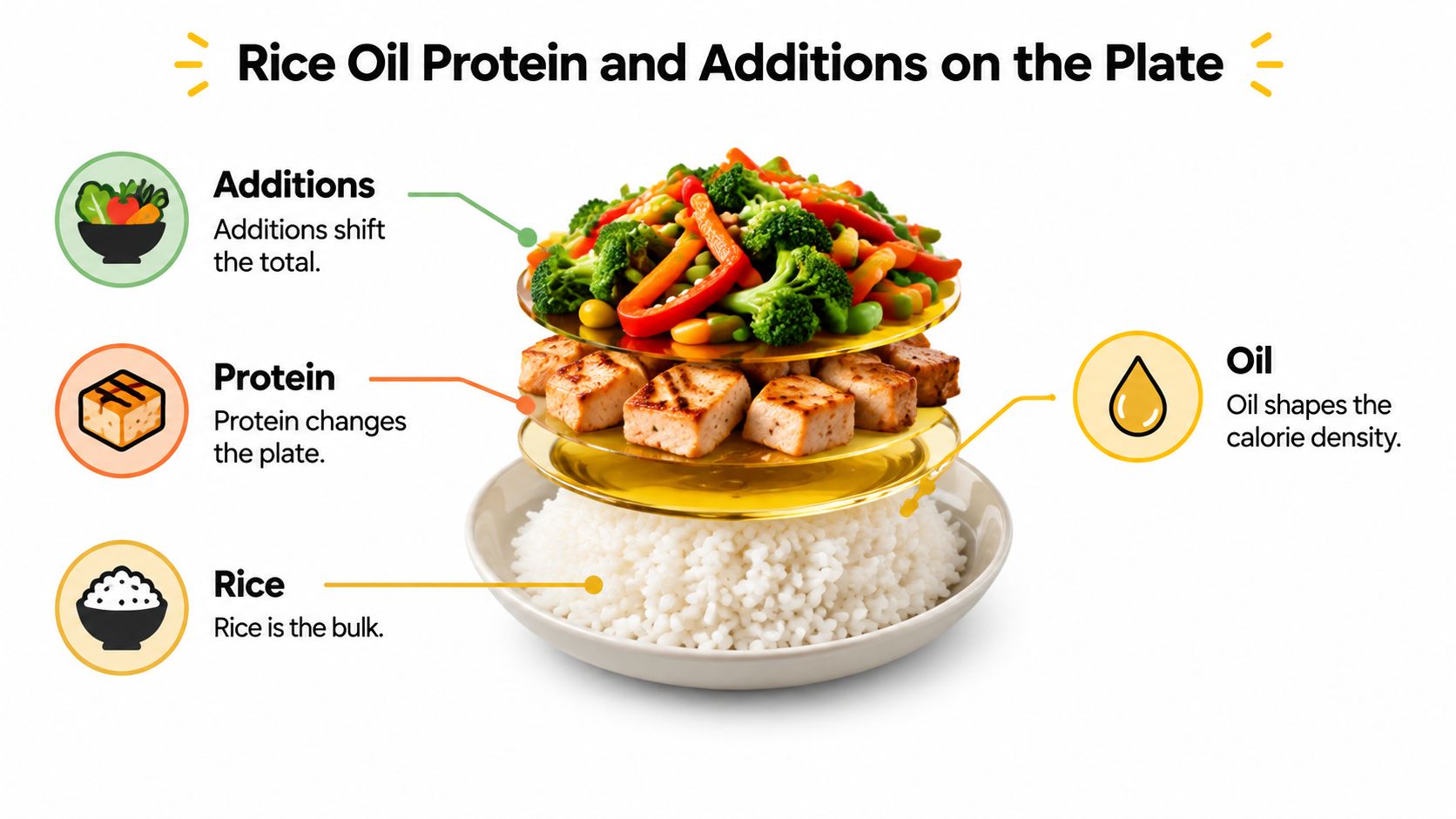
A useful way to inspect the dish is to separate the bulk ingredient, cooking fat, protein, and additions. The diagram illustrates those layers without assigning a universal calorie value to any combination.
Rice and oil need different questions
Rice supplies the bulk and much of the carbohydrate in the reference preparation. When you inspect a recipe, ask whether the finished dish is predominantly rice or whether substantial amounts of other ingredients replace it.
Oil is harder to judge after cooking. It can coat the grains and disappear into the mixed dish, so a photograph can't tell you how much went into the pan. Visible gloss may prompt a preparation note, but it isn't a reliable oil measurement.
At home, record the cooking oil when you make the batch. For takeaway, acknowledge that it's unknown rather than assigning an exact amount based on appearance.
Protein changes more than the dish name
Egg, shrimp, pork, and ham don't make interchangeable recipes. Protein additions change both the calorie estimate and the nutrition profile, especially when the type and amount differ.
Don't choose an entry merely because its headline ingredient matches. Shrimp fried rice can still contain egg and generous cooking oil; vegetable fried rice can still be made with a rich preparation. The headline tells you something, but not everything.
- Egg and meat: Describe what's present instead of reducing the mixture to its most visible ingredient.
- Vegetables: Note whether they replace some of the rice or are scattered through the same rice-heavy portion.
- Sauces: Keep sweetened sauces and table additions separate from assumptions about the base dish.
A lower-energy-density version depends on the overall balance. Adding vegetables without changing anything else isn't the same recipe adjustment as replacing some richer ingredients with vegetables.
The cooking video offers another opportunity to watch ingredients enter a mixed rice dish. Use it as cooking context, not as nutrition evidence for your own plate.
Match the description to your tracking workflow
A useful meal description might identify egg, shrimp, peas, and sauce, then flag the cooking oil as unknown. That's more informative than selecting a generic entry and assuming its recipe matches.
If you're comparing places to keep those details, the food-tracking app comparison is a relevant starting point. Judge a workflow by whether it helps you preserve the portion and preparation information you know, rather than by how confidently it displays a total.
Why the Same Dish Has Many Recipes
Fried rice makes more sense as a recipe category when you consider its history. It wasn't developed as a standardized packaged food with a fixed ingredient list.
The dish has a documented association with China's Sui dynasty, approximately 589–618 CE, and is commonly described as a practical use for leftover cooked rice; historical accounts also connect the popularization of Yangzhou fried rice with Yi Bingshou, a Qing-period official who lived from 1754 to 1815, according to the history and regional variations of fried rice.
A method rather than a fixed formula
The basic method is flexible: stir-fry cooled rice with oil, then incorporate eggs, vegetables, meat, or seafood. A cook can change the available ingredients without abandoning the dish.
That flexibility matters more for food logging than finding a single supposedly definitive recipe. If the household changes its leftovers, the mixture changes. If a restaurant uses a different balance of rice, oil, and additions, the name may remain familiar while the meal differs.
Yangzhou fried rice became a well-known version. Later preparations are associated with shrimp, pork or ham, egg, peas, and scallions, illustrating how several protein ingredients can appear in the same dish.
A culinary name can identify a tradition without identifying a nutritional formula.
Regional identity doesn't settle the calorie estimate
Chinese migration helped spread fried rice internationally, with regional adaptations changing ingredients and portions. That history helps explain why a menu name is a weak substitute for a recipe description.
Consider these as different preparations, not interchangeable database entries:
- An egg-and-vegetable pan: Its description should reflect that mixture.
- A Yangzhou-style plate: Multiple protein additions deserve to be recorded.
- A richer restaurant preparation: The cooking method and fat remain relevant even if the menu name sounds familiar.
None of these descriptions establishes a calorie total by itself. They help you select or build an entry that resembles the meal.
The practical lesson is to respect the dish's variety rather than force it into a universal serving. A useful record retains the rice quantity, cooking fat when known, protein, sauces, and serving weight. The recipe name provides context; it doesn't replace those details.
How to Log Fried Rice More Honestly
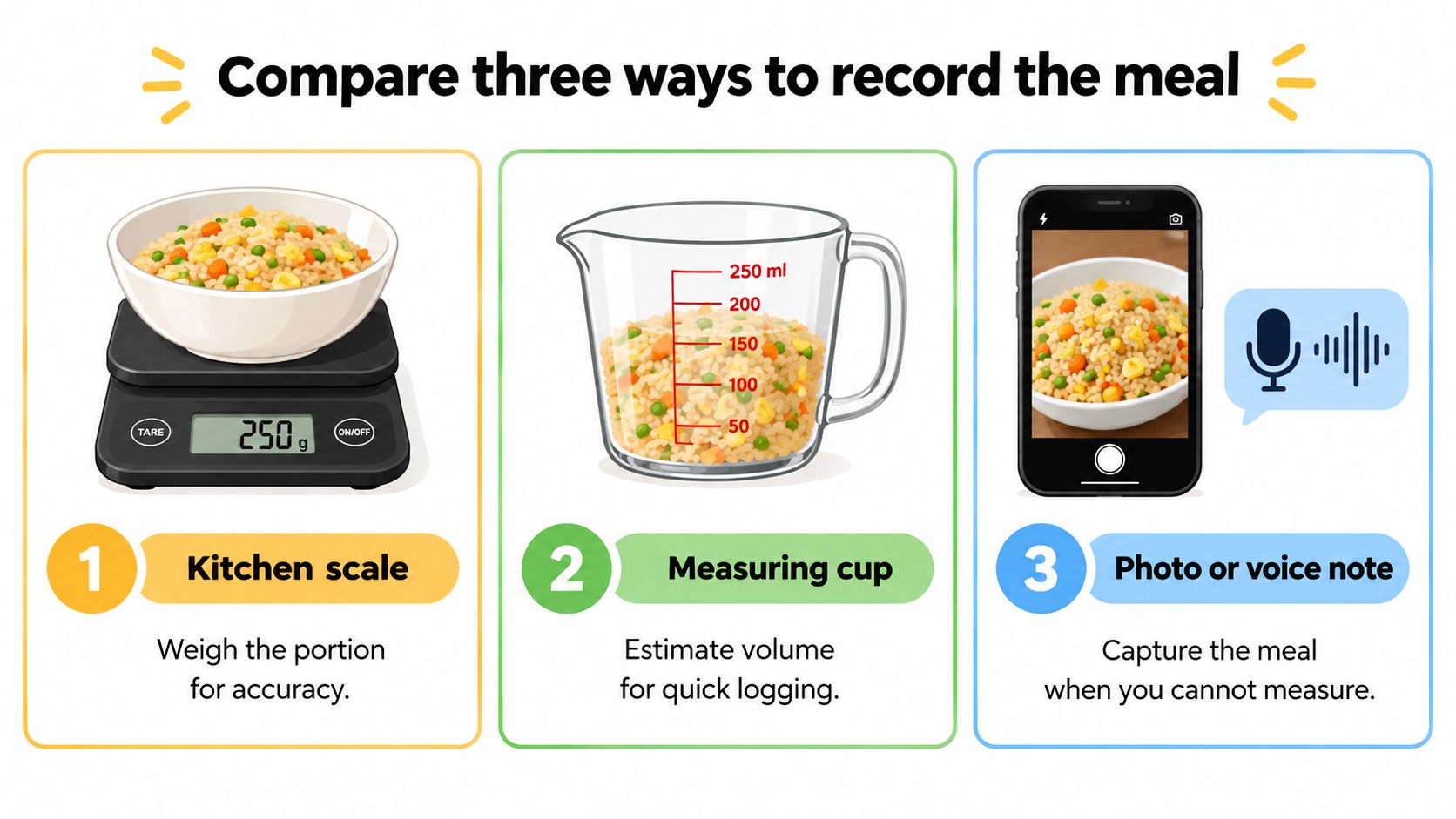
Choose a recording method based on what information you can capture, not on which method seems most suitable. A kitchen scale, measuring cup, and phone each solve a different part of the task.
The comparison below separates measuring the food from recording it. Those jobs overlap, but they aren't identical.
Compare what each method captures
| Method | What it contributes | What still needs judgment |
|---|---|---|
| Kitchen scale | The mass of your serving | Recipe composition and hidden cooking fat |
| Measuring cup | A measured volume | The weight and suitability of the chosen cup entry |
| Photo or voice note | A quick meal record and ingredient description | Portion mass, hidden ingredients, and preparation |
A scale is strongest for portion mass. It doesn't identify ingredients or calculate a restaurant recipe, so weighing shouldn't be confused with knowing the entire nutritional composition.
A measuring cup can work well enough for a home meal when you use it. It's less useful as a label attached to a deep container you haven't measured.
A photograph preserves the meal's appearance, while a voice note lets you describe details that aren't obvious in the image. Neither input should make you forget what remains unknown.
Combine measurement with a useful description
For photo-based logging, keep the meal visible and add the information the image can't establish. A practical description includes the serving amount, visible proteins, vegetables, sauce, and any known preparation details.
The guide to counting calories from photos is a relevant resource when deciding how photography fits your routine. Treat the image as part of the record, not proof that hidden oil or container weight has been measured.
Navilo Health is one consumer option for keeping that record: its stated functions include photograph or voice meal logging, calorie and macronutrient counting, and workout, sleep, water-intake, and fasting tracking. Those functions offer a place to keep nutrition beside other daily records; they don't establish a documented accuracy rate or make the application a clinical service.
- When you can measure: Keep the measured amount with the entry.
- When you can only estimate: State the portion assumption rather than presenting it as a measurement.
- When the recipe is unknown: Preserve a short preparation note instead of inventing ingredient quantities.
An honest estimate can still be useful. The important distinction is knowing which details you measured, which you observed, and which you had to infer.
What to Record with Your Next Plate
Before eating, look at the full plate or container and decide what portion is yours. If you're saving some for later, separate it before you start rather than reconstructing the meal from the leftovers.
Keep the portion and ingredient description together. That gives you something concrete to compare with a later meal instead of repeating the same guess.
Make the entry recognizable
Use a short checklist that captures the details you'll otherwise forget:
- Portion: Save the measured weight or the clearest available estimate.
- Preparation: Note whether the oil was measured, visibly generous, or unknown.
- Protein and vegetables: Name the ingredients you can identify.
- Sauce: Include what was mixed in or added afterward.
- Amount eaten: Adjust the record if you leave food behind.
Don't turn uncertainty into false detail. “Restaurant preparation, oil unknown” is a more honest note than an exact cooking-fat quantity you didn't observe.
Keep a repeatable routine
In the app described above, start a meal entry by photograph or voice, then keep the portion and ingredient notes with your record using the available workflow. Use its calorie and macronutrient counting as an estimate informed by those details, not a reason to discard them.
If you're choosing a recording tool, use this guide to choosing a food tracker as a starting point for considering your routine. The useful choice is one you'll use consistently without confusing convenient input with complete knowledge of a mixed dish.
You don't need to solve every ingredient before dinner. Make the decision you can control today: stop assigning the same generic cup to every plate, and record the serving you're about to eat.
Visit Navilo Health to record meals through photographs or voice and track calories and macronutrients alongside workouts, sleep, water intake, and fasting. For your next fried-rice meal, capture the dish and keep a portion estimate and ingredient description with your record so you're tracking your plate, not a generic serving.