How to Calculate Macros: Calories, Protein, Carbs and Fat
Learn how to calculate macros step by step: estimate calories, set protein, carb and fat targets, and convert them into daily grams.

You've entered your meals into a tracker, but dinner has left you over your fat target and short on protein. The calorie total looks close, yet the app makes the day feel unfinished. Should you eat more, skip something tomorrow, or change the targets?
Learning how to calculate macros should make those decisions easier, not turn meals into a daily arithmetic test. The practical approach is to estimate your needs, choose workable protein, fat, and carbohydrate targets, and review what happens over time. Treat those targets as a starting range to test, not a verdict on whether you ate correctly.
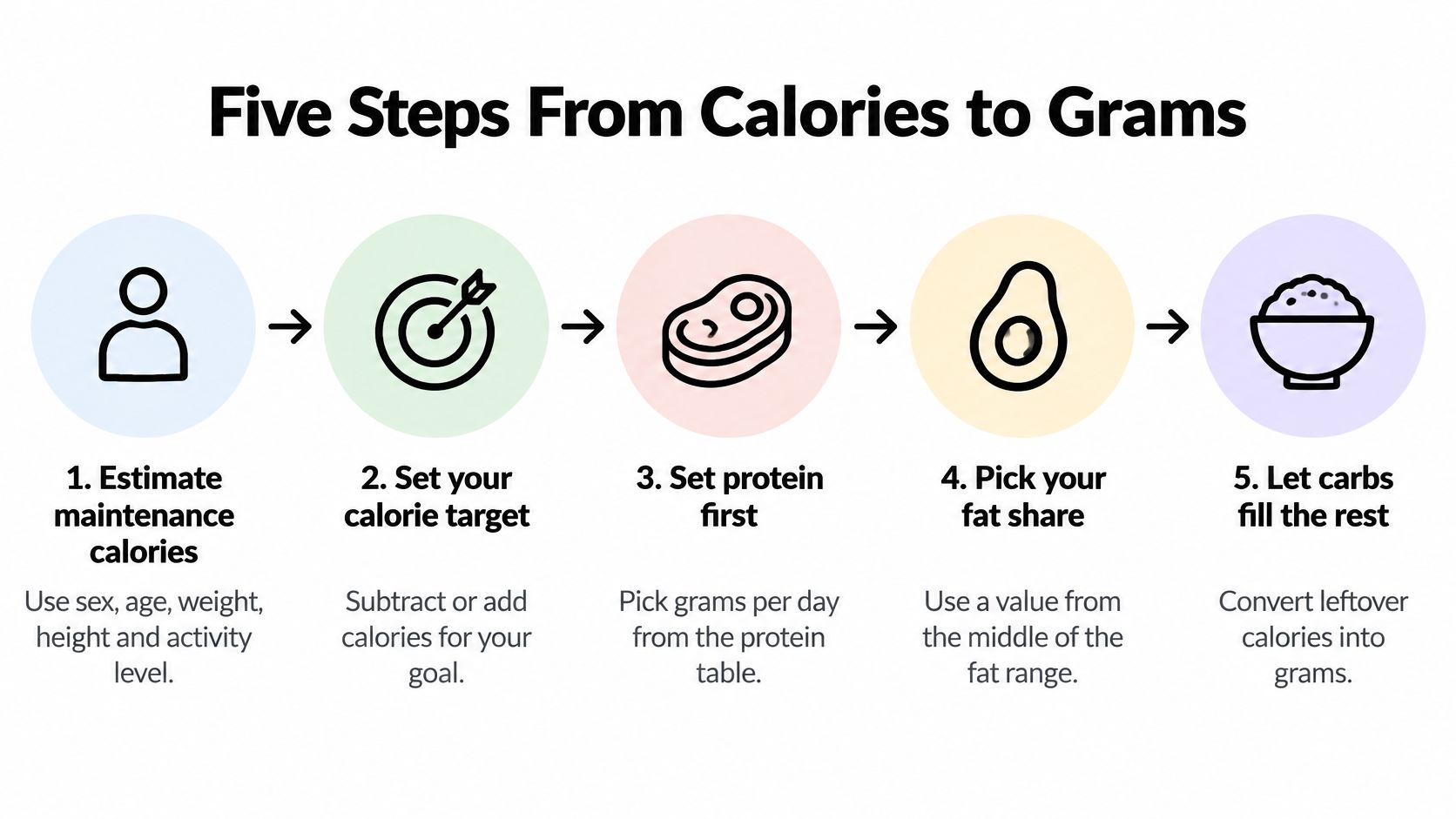
Five Steps From Calories to Grams
A useful macro setup connects your goal to meals you can repeat without constantly correcting your food choices.
Consider a moderately active man who wants to lose fat while continuing his usual strength training. We'll use that same situation throughout: his priority is a manageable eating pattern that supports training, not the fastest possible scale change.
- Estimate maintenance calories. Use a calculator that considers sex, age, height, weight, and activity. Maintenance is the estimated intake at which his weight would stay broadly stable.
- Adjust for the goal. For fat loss, choose an intake below estimated maintenance. Start conservatively rather than selecting the lowest target he thinks he can tolerate.
- Set protein from body weight. Choose a body-weight-based target appropriate to his goal and circumstances, ideally with a dietitian's guidance when needs are unclear.
- Allocate calories to fat. Leave room for the foods he enjoys and normally cooks with, rather than treating fat as something to eliminate.
- Give carbohydrate the remaining calories. Convert each allocation into grams using the calculator's nutrient-energy settings, then check whether the resulting meals look practical.
The sequence is easier to follow visually.
Check the result against real meals
Before accepting the output, sketch an ordinary workday of eating. Can he include breakfast, lunch, dinner, and his preferred snacks without rebuilding his entire routine?
Practical rule: A mathematically tidy target that requires meals you won't eat is a poor starting target.
If the plan demands a dramatic overhaul, simplify it. Keep familiar meals, identify their main protein sources, and adjust portions deliberately. The calculated result is a proposal to test, not a requirement to follow regardless of hunger, recovery, or everyday life.
How to Estimate Your Daily Calorie Needs
A calorie calculator usually starts by estimating energy needs at rest, then adjusts for activity. The Mifflin-St Jeor equation is a common calculator option, but the important practical distinction is between the resting estimate and the maintenance estimate. They aren't interchangeable.
Enter your current measurements and describe your usual activity, not the week you hope to have. For our example man, regular gym sessions matter, but so does spending most of the working day seated.
Choose activity from your whole week
Think about commuting, work, household tasks, training, and rest days together. Don't let a demanding workout stand in for an otherwise sedentary routine.
Maintenance calories by activity level for the example man
| Activity level | Typical week | Multiplier | Maintenance for the example man |
|---|---|---|---|
| Sedentary | Desk job, little or no exercise | Lowest activity adjustment | Lowest estimate |
| Light | Occasional exercise with mostly seated days | Small activity adjustment | Above the sedentary estimate |
| Moderate | Regular exercise alongside ordinary daily movement | Moderate activity adjustment | His provisional starting estimate |
| Very active | Frequent demanding exercise | Large activity adjustment | Higher than his starting estimate |
| Extra active | Physically demanding job plus daily training | Highest activity adjustment | Highest estimate |
When unsure between descriptions, choosing the lower category is a reasonable starting convention. Record that choice so you can revisit it instead of repeatedly switching calculator settings.
A tall, muscular, or older reader shouldn't assume an activity category fixes every limitation in the estimate. If the result seems implausible, get help interpreting it rather than forcing the calculator to produce a preferred answer.
Make the goal adjustment separately
Our example man first saves his estimated maintenance intake. He then chooses a modest reduction for fat loss, leaving his activity assumption unchanged.
That separation matters. If he changes both the activity category and the goal setting at once, he won't know which assumption explains the resulting target.
The broader weight-loss and fat-burning guide can help frame that goal without making the macro split the entire strategy.
- Record the assumptions. Save the activity category and goal setting alongside the calorie target.
- Keep the routine recognizable. Avoid pairing a new food target with an ambitious exercise overhaul.
- Flag uncertainty. An irregular work schedule or changing training load deserves a note, not false confidence.
The estimate becomes useful when you compare it with experience. Until then, it's just the best available starting point.
Choosing Protein, Fat and Carb Targets
Set protein first, fat second, and carbohydrate last. Protein and fat have narrower sensible bands, so fixing them early keeps the decision clean. Carbohydrate then absorbs whatever calories remain.
Numbers make the order concrete. If our example man weighs 80 kg, a protein band of roughly 1.6 to 2.2 g per kg gives him a working range of about 130 to 175 g a day. A pick at 2.0 g per kg lands on 160 g. He treats that figure as a first estimate with room either side, then lets his weekly weight trend and training performance decide whether he slides up or down inside the band.
Fat needs its own allowance before carbohydrate gets the remainder. For the worked example, holding fat near 25 to 30 percent of calories leaves room for normal cooking and shared meals. Pushing it lower only makes sense if training fuel demands it.
Match the setup to the purpose
The bands below are illustrative starting points for a healthy adult, sized wide enough to hold a first guess plus its correction.
Illustrative macro starting bands by goal
| Goal | Protein (g per kg) | Fat (% of calories) | Carbohydrate |
|---|---|---|---|
| Fat loss | 1.6 to 2.2 | 20 to 30 | Remainder after protein and fat |
| General health and maintenance | 1.2 to 1.6 | 25 to 35 | Remainder after protein and fat |
| Muscle gain | 1.6 to 2.2 | 20 to 30 | Remainder after protein and fat |
| Endurance training | 1.2 to 1.6 | 25 to 35 | Remainder, usually the largest slice |
The width of each band is the tolerance built into the plan. Pick a point inside it, then adjust from what the scale trend and session quality show over the following weeks.
A reader chasing muscle can pair the band with the guide to gaining muscle so the food plan stays tied to the training goal. The split supports that work; it cannot replace progressive training.
Medical conditions, pregnancy, or heavily restricted diets change the inputs. In those cases, get individualized advice before locking a band.
Don't confuse typical intake with your target
In 2023, the Australian Bureau of Statistics reported average usual energy intake at 43% carbohydrate for both sexes, 32% fat for males and 33% for females, and 19% protein for both sexes in its usual nutrient intake results.
Those figures describe what a population already eats. A target built to change body composition or fuel a training block answers a different question.
Pick a split that fits your meals, training, and preferences. Looking balanced on a chart is a weak reason to choose it.
For our example man, the test is practical: does 160 g of protein plus a moderate fat allowance still leave enough carbohydrate for satisfying dinners and decent sessions? If the meals get awkward, he moves within the bands before questioning his discipline.
Turning Calories and Targets into Grams
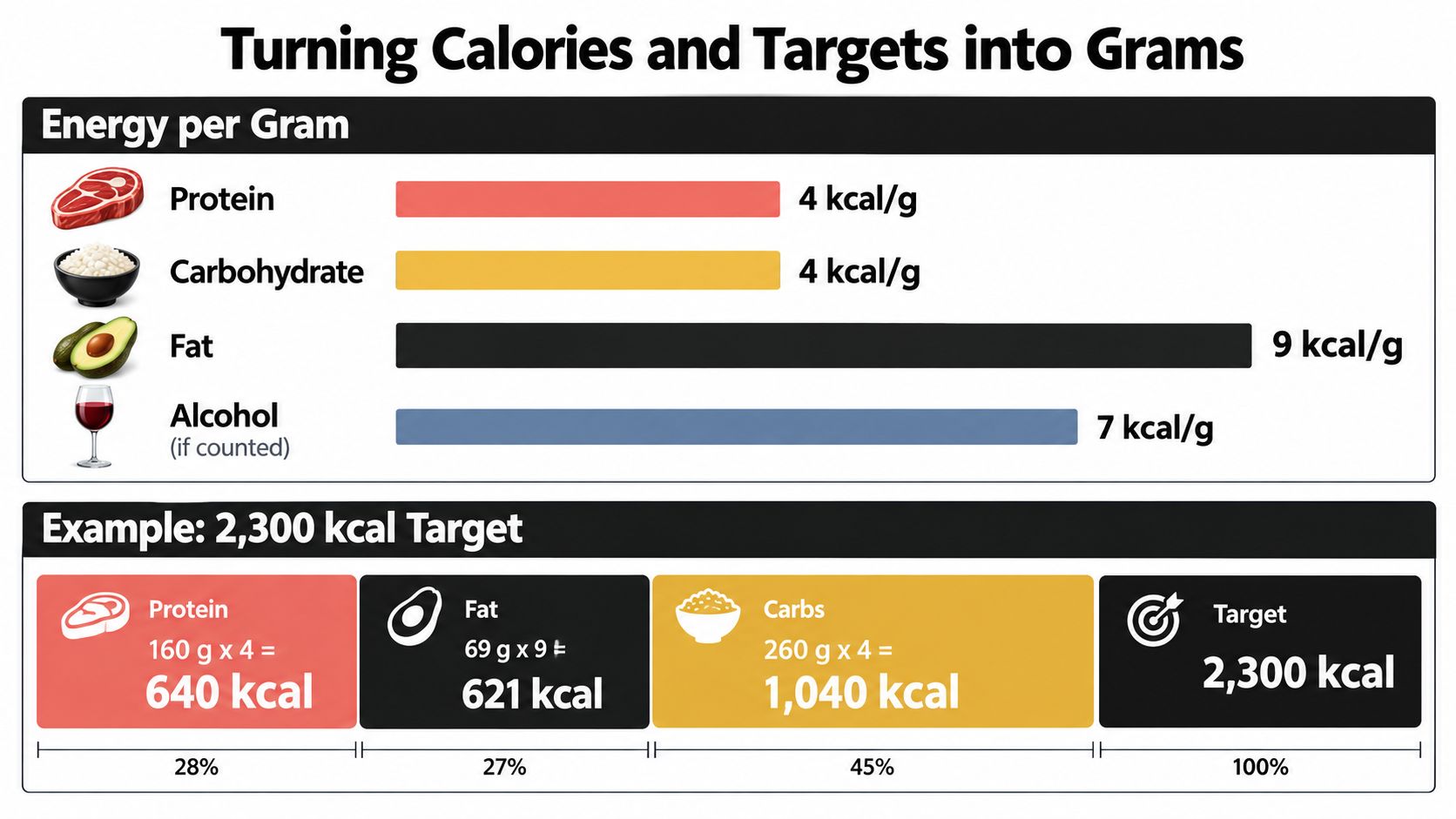
Grams = calories allocated to a macro ÷ that macro's energy value per gram.
A calculator can handle that arithmetic, but understanding the sequence helps you catch confusing outputs. Protein, fat, and carbohydrate don't convert from calories into identical gram amounts, so equal-looking calorie allocations won't necessarily produce equal-looking portions.
For our example man, work through the calculation in this order:
- Reserve protein calories. Convert his chosen protein grams into their calorie contribution.
- Reserve fat calories. Convert the selected fat allowance into grams and account for those calories.
- Calculate the remainder. Subtract the protein and fat calories from his total calorie target.
- Convert the carbohydrate allowance. Turn those remaining calories into carbohydrate grams.
The visual below illustrates the conversion workflow.
Compare splits without treating them as prescriptions
At the same total calorie intake, allocating more calories to carbohydrate leaves fewer available for protein or fat. That's a budgeting choice, not an automatic improvement.
How gram targets change across illustrative splits
| Split | Protein (g) | Carbs (g) | Fat (g) |
|---|---|---|---|
| Balanced | Set deliberately | Moderate allocation | Moderate allocation |
| Higher carbohydrate | Retain the chosen target | Larger allocation | Smaller allocation |
| Lower carbohydrate | Retain the chosen target | Smaller allocation | Larger allocation |
| Protein-first personalized | Based on individual needs | Remaining allowance | Chosen to suit meals and preferences |
The personalized option is the most useful starting framework here. It avoids copying a percentage pattern without checking what the resulting grams mean for the person eating them.
Make the output usable
Save rounded, readable targets rather than treating calculator decimals as meaningful instructions. Don't add an unwanted snack solely to close a tiny gap on the screen.
Our example man should also check whether his usual foods contribute to several macros at once. A mixed meal isn't just a protein serving plus a carbohydrate serving; its ingredients need to fit the overall allocation.
Calculation check: Confirm that your tracker's calorie goal and macro settings belong to the same setup before changing your food.
If the totals look inconsistent, inspect the settings and entries first. Rebuilding the plan should come after checking the arithmetic, not before it.
How Precise Your Macro Numbers Need to Be
A macro target isn't a laboratory measurement. Writing down a precise number doesn't make the food record equally precise.
The illustration below highlights why a label and a portion estimate shouldn't be treated as interchangeable.
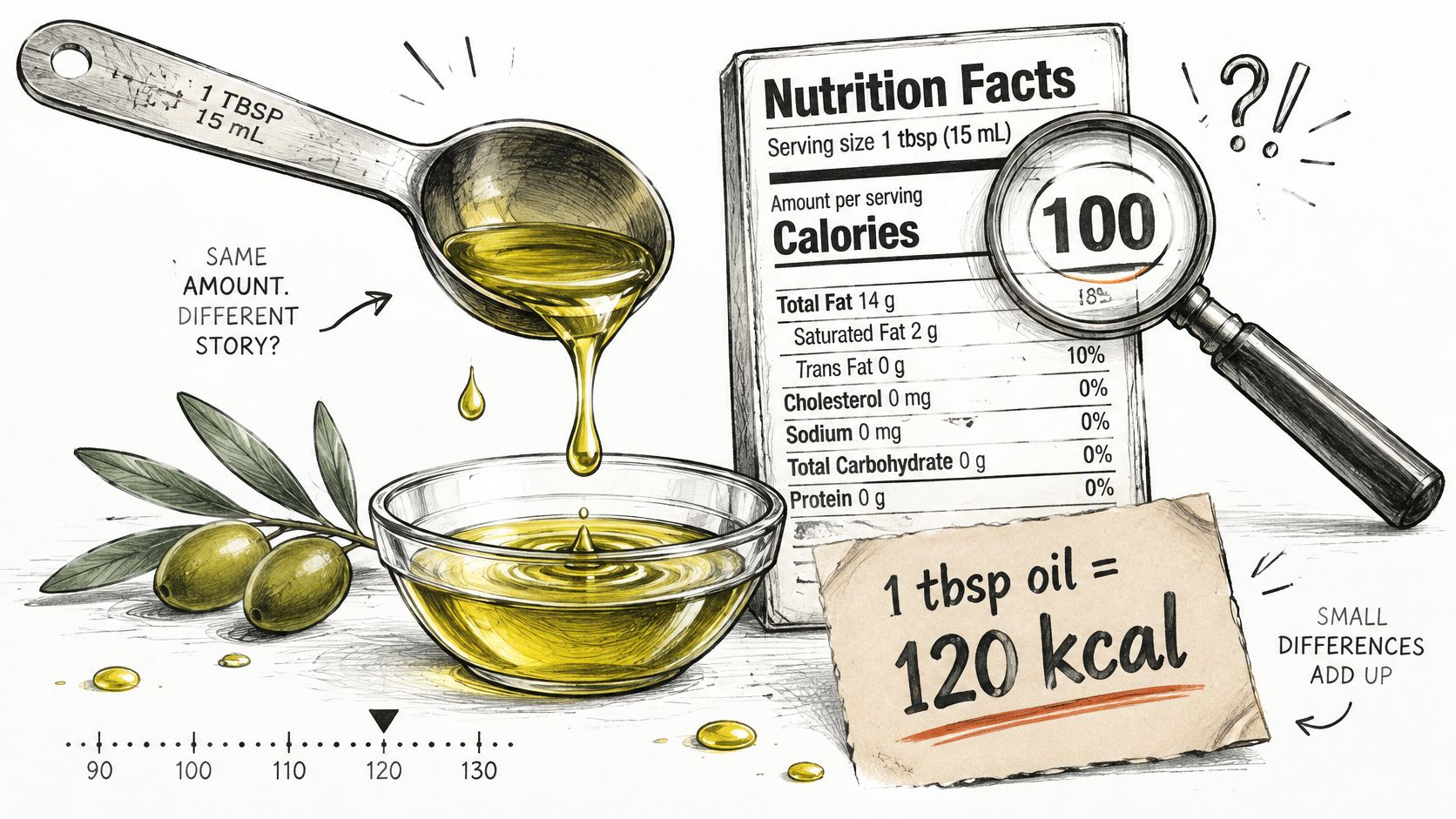
The 2025 Dietary Guidelines Advisory Committee noted that calorie content varies across food and beverage choices, and that portion size and energy density independently affect daily energy intake in its executive summary. That supports treating calculated targets as estimates rather than exact measurements.
Labels round, recipes differ, and restaurant portions aren't standardized to your tracker entry. Mixed dishes and cooking fats deserve particular attention because their ingredients may be difficult to judge from the finished plate.
Use a tolerance band, not a pass-or-fail line
A practical tolerance band means allowing ordinary variation while keeping the overall pattern recognizable. It doesn't require inventing a supposedly universal acceptable error margin.
Review weekly averages alongside body-weight direction, hunger, waist measurements, and training performance. Our example man shouldn't change his targets because an isolated weigh-in disappoints him.
What to change based on a sustained trend
| Observed pattern | Adjustment | Keep unchanged |
|---|---|---|
| Weight moving as intended and training manageable | Leave the setup alone | Current targets and logging approach |
| Weight persistently flat with consistent logging | Review uncertain entries, then consider a small calorie reduction | Appropriate protein target |
| Weight falling faster than intended | Consider increasing intake and reviewing the goal | Deliberate protein planning |
| Training performance dropping | Review carbohydrate availability, sleep, and the overall deficit | A balanced eating structure |
For uncertain meals, the guide to counting calories from photos provides a relevant starting point. Review photo-based estimates rather than assuming the image captures every ingredient or portion accurately.
Use the accompanying video as another way to think through the tracking process.
Change a variable deliberately, then observe the result. For fat loss, reconsider the overall calorie target before replacing the entire macro split.
Choose Your First Macro Setup and Review It in Two Weeks
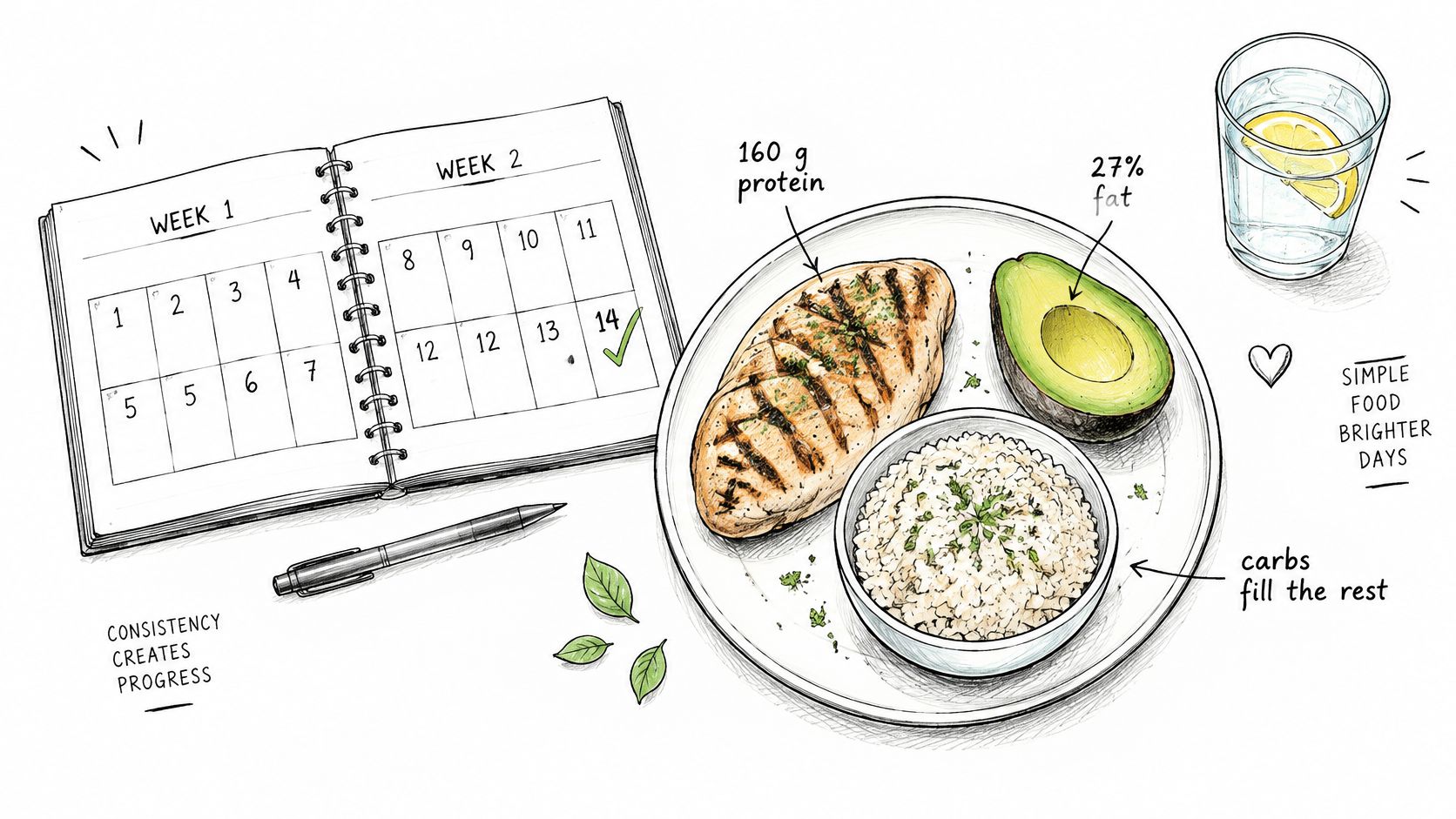
Start with protein first, reserve a workable fat allocation, and let carbohydrate fill the remaining calorie budget. Then pick a specific review date two weeks out, before you log your first meal. Fourteen days gives the scale enough readings for a weekly average to mean something, and it is short enough that a miscalibrated setup costs you little.
For our example man, the initial task is straightforward: follow a repeatable eating pattern, record it accurately, and note how training and appetite feel. A food scale can help clarify uncertain portions if using it feels manageable, but it doesn't need to become a permanent requirement.
Use a meal-planning record to connect the targets with food you actually enjoy.
Make consistency easier rather than stricter
A 2025 systematic review of dietary self-monitoring studies, covering trials where adults were asked to record their food intake, reports average adherence of 0.55 with self-management, 0.72 with customized feedback, and 0.83 with intensive support, as described in the research on food self-monitoring. Adherence here means the proportion of assigned logging days participants completed, so read these numbers as "how often people kept recording," not as a pass-or-fail score for any one person.
The same review notes limited evidence in adults over 30, a group that includes our example man. That gap does not weaken the practical lesson: logging holds up when the process comes with feedback or support, and it frays when someone is left alone with a target and an app. Build your two-week block around making the process repeatable rather than stricter.
- After a missed log, resume normally. Don't compensate by skipping meals or trying to reconstruct every uncertain bite.
- If detail becomes burdensome, simplify. Use meal templates, protein-and-produce priorities, or a less granular record.
- Separate performance from weight loss. Decide which outcome matters most before interpreting the results.
Know when tracking isn't helping
Pause rigid tracking and seek professional help if you notice rising food anxiety, guilt after eating, compensatory exercise, or obsessive scale checking. These aren't signs that you need a stricter target.
If you have an eating-disorder history, are pregnant, or have a medical condition, speak with a doctor or registered dietitian before adopting gram-based targets. A less numerical approach may be more appropriate.
Write down your calorie estimate, protein target, and a date two weeks from today. At that review, weigh the physical trend against whether the process is sustainable before deciding what to change.
Our app counts calories and macros, giving you a way to record intake while you test your starting setup. Visit Navilo Health to begin tracking, and use your planned review date to assess the pattern rather than judging each day in isolation.